knitwear · materials · how to buy
Why Knitwear Itches, and Why It Is Usually Not an Allergy
House of Nova · July 28, 2026 · 4 min read
Most people who say they are allergic to wool are not. What they have met is a mechanical problem with a measurable threshold, and knowing the number changes how you shop.
The prickle is physical, not immune
When a fibre presses against your skin, one of two things happens. A fine fibre bends. A coarse one does not — it is too stiff, so instead of giving way it indents the skin, and the nerve endings underneath report that indentation as prickle.
That is the whole mechanism. It is a question of the fibre's stiffness, which is governed by its diameter. It is not histamine, and it is not an immune response. True wool allergy exists but is genuinely rare; the reviews of the evidence keep finding that what is being described is almost always this mechanical irritation instead.
This distinction matters practically, because an allergy would mean avoiding a material and prickle means avoiding a grade of it.
The number is measured in microns
Fibre diameter is measured in microns — thousandths of a millimetre. The threshold where prickle begins is around 30 to 32 microns. Below it, fibres bend against the skin and you feel softness. Above it, they hold their shape and you feel prickle.
The industry has a term for this: the prickle factor, which is the percentage of fibres in a sample measuring more than 30 microns. It is not a vague comfort claim; it is a count.
This is why "wool" as a category tells you nothing. A coarse carpet-grade wool and a superfine merino are the same fibre type with entirely different behaviour against skin, because they sit on opposite sides of that threshold. Superfine and ultrafine merino bend easily on contact, which is why they are the wools recommended for people with sensitive skin or eczema — and why a merino base layer can be comfortable to someone who cannot wear a lambswool jumper.
Smoothness is a second variable
Diameter is the main term but not the only one. Wool fibres have a scaled surface — overlapping cuticle cells, like roof tiles. Those scales are what let wool felt, and they also catch on skin.
Cotton has no scales. Its surface is comparatively smooth, which is why cotton can feel softer than a wool of the same or even finer diameter. Between two fibres of equal micron count, the smoother one wins on comfort.
So there are two questions, not one: how thick is the fibre, and what is its surface like.
What this means when you are buying
Ask for the micron count, not the fibre name. A good knitwear brand knows it. "Merino" spans a wide range; "18.5 micron merino" is a fact.
Test it on your neck, not your hand. The skin on your palms and fingertips is far less sensitive than the skin on your neck and inner wrist, which is exactly where a jumper sits. A knit that feels fine in your hands can be unwearable at the collar.
Distinguish the yarn from the construction. An open, airy knit in a coarse yarn puts fewer fibre ends against you than a dense one in the same yarn. Construction can soften a borderline fibre, though it cannot rescue a genuinely coarse one.
Treat "soft" as marketing and "microns" as information. One is a claim about how it feels to whoever wrote the copy. The other is a measurement you can compare.
Where the House sits on this
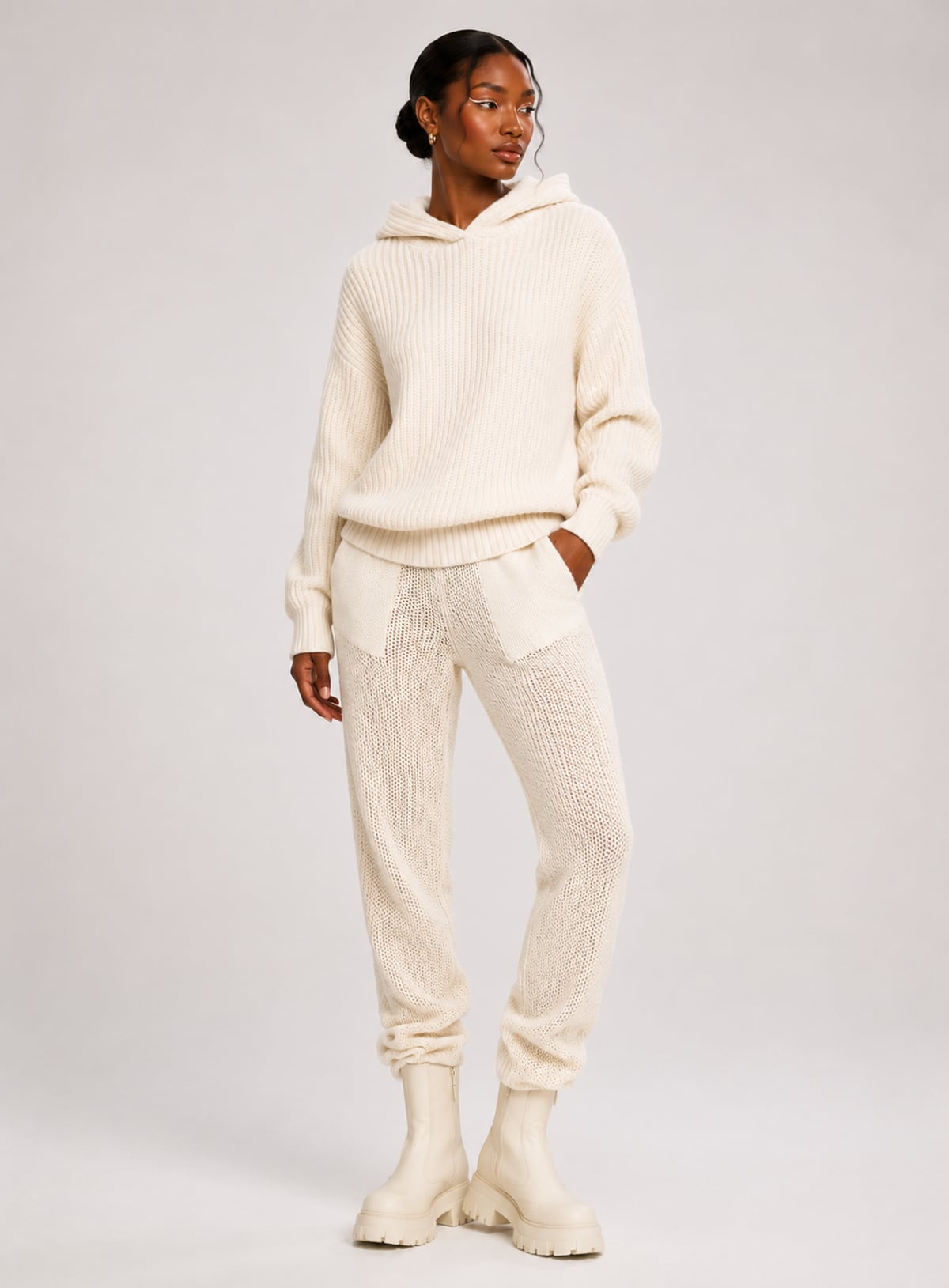
House of Nova knitwear is made in non-wool yarns. That is a construction decision rather than a claim about wool: it removes the variable entirely, so a piece can be worn against bare skin without anyone having to work out where a particular fleece sat on the micron scale.
It is worth being clear about the trade. Wool does things the alternatives do not — it manages moisture unusually well and it insulates when damp. Choosing against it buys predictability against the skin and gives up some of that performance. Which side of that trade is right depends on whether you are dressing for a room or for weather.
Sources
Let Aurra style your next moment.
Generate my look