outerwear · how to buy · materials
What Fill Power Actually Means on a Down Coat
House of Nova · July 21, 2026 · 4 min read
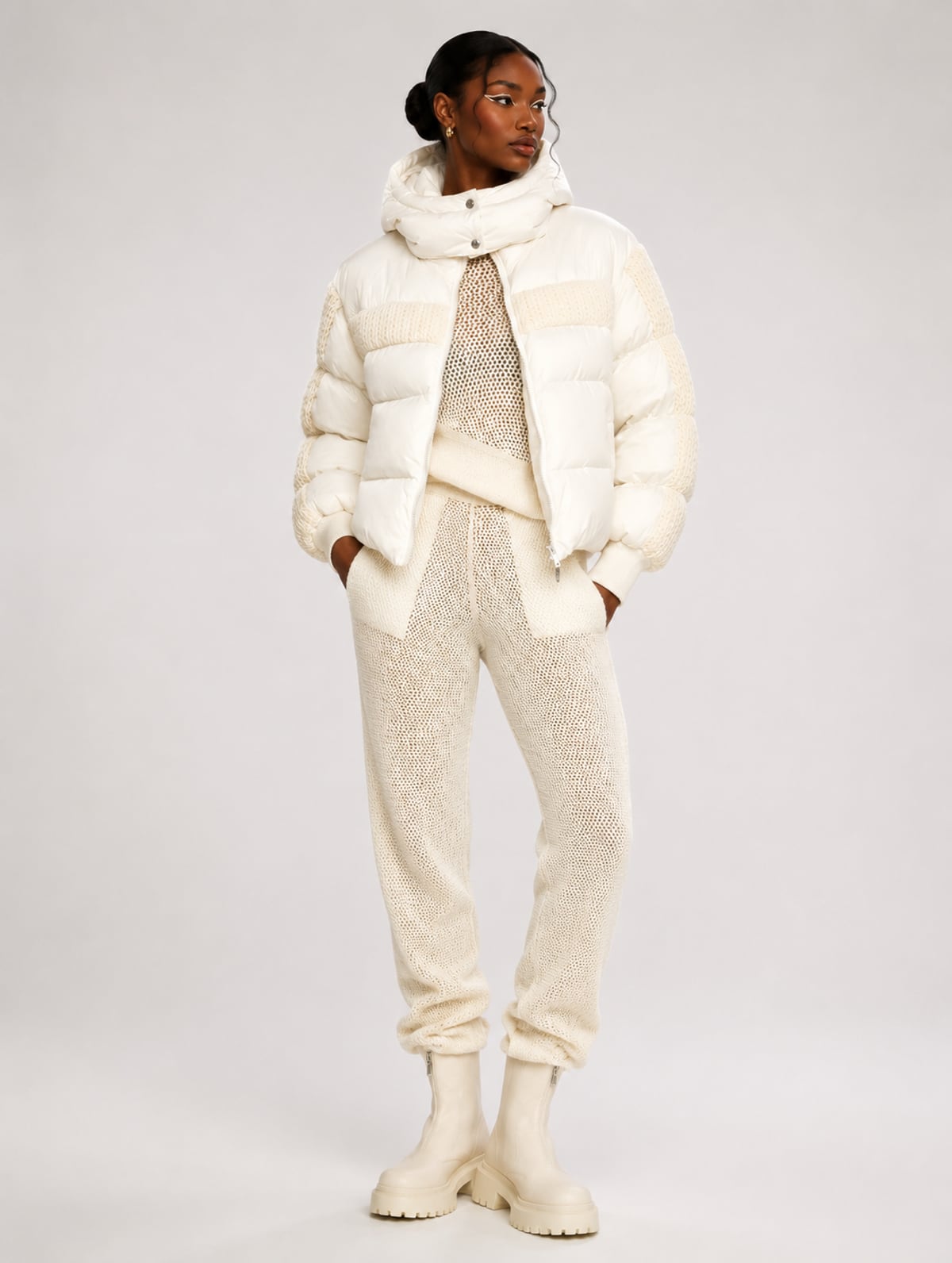
Every down coat above a certain price prints a number: 600, 700, 800. It is the most quoted specification in outerwear and the most widely misread. It does not tell you how warm the coat is.
The number is a measure of loft
Fill power is the volume, in cubic inches, that one ounce of down occupies when it is fully lofted. A sample of conditioned down is placed in a cylinder, a standardised light weight is set on top, and the volume it settles at is the rating. 600 fill power means one ounce of that down expands to 600 cubic inches. 800 means it expands to 800.
So the number describes the quality of the down itself: how much air a given weight of it can trap. Air is the insulator. Down is only the structure that holds it still.
That makes fill power a warmth-to-weight ratio rather than a warmth rating. Higher-rated down reaches the same warmth with less of it, which is why it dominates technical kit where every gram is carried. As a rough map of where the ratings sit in practice: around 600 is a solid everyday coat, 700 to 750 is considered very good, and 800 and above is where garments are built for performance and compressibility rather than for daily wear.
Why an 800 coat can be colder than a 700
Here is the part the marketing tends to leave out. Total warmth is the product of three things:
fill power × fill weight × construction
Fill power is the quality of the down. Fill weight is how much of it is actually in the coat. Construction is how the coat holds that down in place.
A coat with 700 fill power and a generous fill weight can be warmer than one with 1000 fill power and very little down in it. The high number tells you the down is efficient; it says nothing about how much you were given. A brand can quote an impressive fill power on a garment that is barely filled, and the number will be entirely truthful.
Fill weight is quoted far less often than fill power, which should tell you something. If a coat states both, that is a good sign.
Construction is the part you can see
The third term is the one you can actually assess in a shop, with your hands, without any specification sheet.
Down migrates. Left in an open shell it drifts to the bottom of the garment and leaves the top of your chest with nothing in it. Baffles are the internal walls that stop this, and they are the difference between a coat that stays warm in year five and one that does not.
The cheap method is sewn-through: the outer and inner shells are stitched directly together in lines, creating channels. It is light and it works, but every stitch line is a seam with no insulation in it — a cold line straight through the garment. You can see these as the classic flat quilted rows.
The better method is box-baffle: strips of fabric are sewn between the two shells so each chamber is a three-dimensional box. The down can loft fully and there is no cold seam. It uses more material and more labour, and it costs more.
Neither is wrong. A sewn-through coat with well-placed seams is a perfectly good garment. But if two coats quote the same fill power and one costs twice as much, construction is usually where the money went, and it is visible from the outside.
What to actually ask
Four questions, in order of how much they tell you:
- What is the fill weight? If they answer, take them seriously. If only fill power is published, you know the down's quality and nothing about the quantity.
- How is it baffled? Sewn-through or box construction, and where. Some coats box the body and sew through the sleeves, which is a reasonable compromise.
- Where is the down placed? A well-designed coat is not filled evenly. It puts more where you lose heat and less where bulk would stop you moving.
- What is the shell? Down is useless wet. The shell's job is to keep weather out and let moisture from your body escape.
None of this requires a lab. It requires knowing that the number on the tag answers one question out of four, and asking the other three.
Sources
Let Aurra style your next moment.
Generate my look